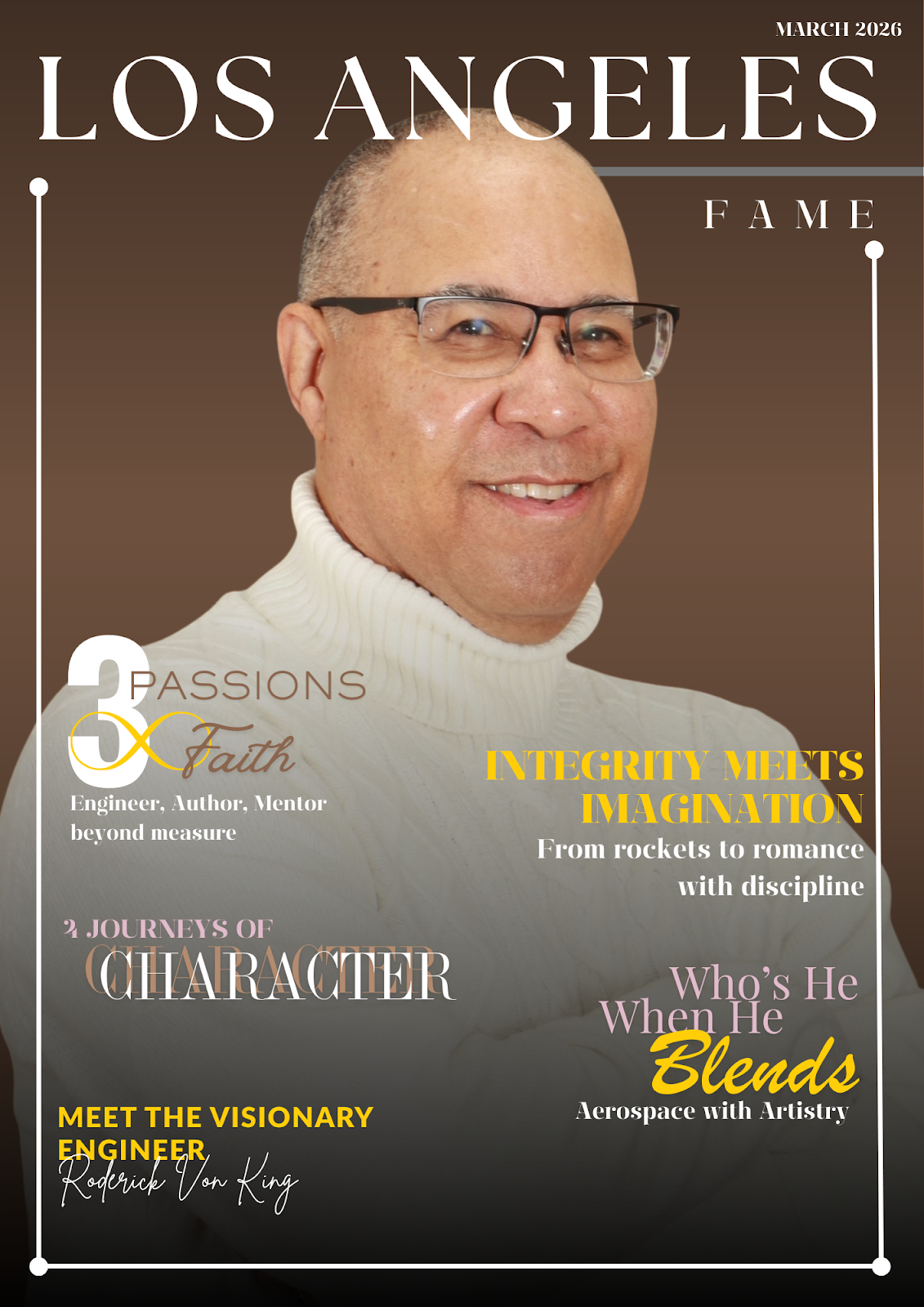
Photo by: Lauren Abidin
In a world where most people define themselves by a single profession, Roderick Von King stands as a testament to what it means to live multiple callings and to excel in each with discipline, integrity, and imagination. Aerospace engineer. Record label founder. Award-winning author. Screenwriter. Mentor. His journey is not one of random reinvention, but of purpose-driven evolution.
From Loyola Marymount to the Aerospace Frontier
Roderick’s professional foundation was built on precision and possibility. After earning his Bachelor of Science in Electrical Engineering from Loyola Marymount University, he entered the aerospace industry in 1976 recruited directly out of college by Rockwell International.
For nearly five decades, he navigated a demanding and highly technical industry with excellence. But beyond technical mastery, Roderick carried a deeper mission. As a minority engineer entering a competitive space during the 1970s, he aspired not only to succeed personally, but to rise into management so he could open doors for others. Representation mattered. Mentorship mattered. Access mattered.
Reaching retirement without ever experiencing a layoff remains one of his proudest achievements a milestone he attributes to faith, perseverance, and unwavering commitment to excellence.
Creative Control and the Birth of a Record Label
While aerospace engineering satisfied his analytical side, music nourished his soul. In 1980, Roderick launched an independent record label to support the solo career of his cousin, Gordon DeWitty. The decision was rooted in a desire for creative control ownership over message, sound, and direction.
As a father raising young children, he later gravitated toward Christian music, motivated by a desire to counteract the increasingly profane lyrics dominating parts of mainstream rap. Faith guided his business decisions. Purpose shaped his productions.
What began as a family-centered venture grew into a platform for meaningful artistic expression — one that reflected his character: principled, intentional, and unafraid to stand apart from cultural pressure.
A Literary Awakening
Roderick’s entry into the literary world came unexpectedly. Challenged by a friend’s wife to write a romance story, he accepted — not casually, but wholeheartedly. Drawing inspiration from a childhood friend’s song, “Why Didn’t We Love?” written by Oliver Davis, he crafted a narrative that would become his first published book in 2023: Why Didn’t We Love?.
The novel resonated deeply with readers. It earned him the International Impact Book Award, along with Author of the Year 2025 in Romance. But for Roderick, accolades are not the destination — they are confirmation that authenticity connects.
His second book, Altar Call – An Honest Depiction of a Path to Salvation, is a work rooted in faith and inspired by a song he wrote. It too received the International Impact Book Award, reinforcing his ability to move seamlessly between romance and spiritual storytelling.
What makes his literary voice distinctive is not trend-chasing, but honesty. He writes from lived experience, conviction, and imagination — never from peer pressure.
Expanding Into Screenwriting
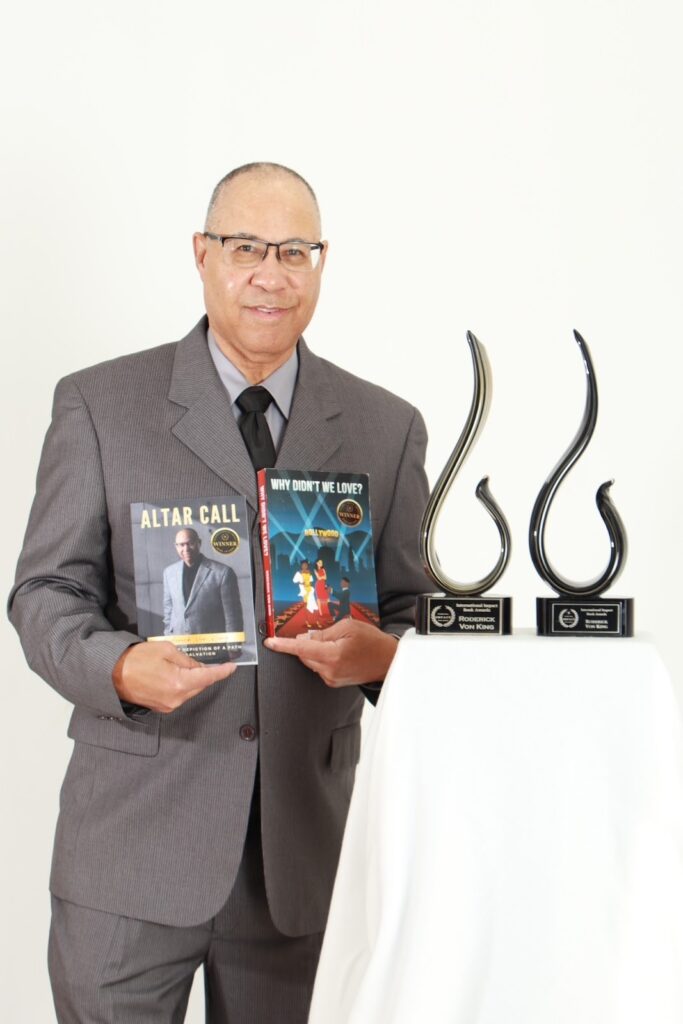
Photo By: Lauren Abidin
Roderick’s storytelling ambitions have now expanded to film. He completed a screenplay adaptation of Why Didn’t We Love? and is actively pitching the project. In addition, he has developed treatments for three more screenplays based on compelling ideas he believes deserve to be brought to life visually.
The transition feels natural. Aerospace engineering taught him structure. Music taught him rhythm. Writing gave him emotional depth. Screenwriting merges all three — technical discipline, creative timing, and human narrative.
Carnival, Culture, and “Last Night in Trinidad”
His upcoming third book, Last Night in Trinidad, marks another creative evolution. Inspired by years of Carnival experiences, the project celebrates Trinidad’s vibrant music, culture, and parade bands. The book will incorporate more than ten Soca songs Roderick wrote in collaboration with local Soca artists and Steel Pan arrangers.
This project reflects his global curiosity and his ability to immerse himself fully in culture before translating it into art. It is not observation from a distance — it is participation, collaboration, and respect.
Additionally, fans can expect a continuation of the fictional character Bobby Vail, first introduced in Why Didn’t We Love?, expanding into future literary works.
Defining Success on His Own Terms

Photos by : Lauren Abidin
Ask Roderick what success means, and you will not hear talk of titles or applause. To him, success is meaningful work that stretches him, staying true to his values, and waking each morning with purpose. It is the discipline to take an idea — whether technical, musical, or literary — and see it through with craftsmanship.
Success also means opening doors. Mentoring engineers. Launching artists. Writing stories that resonate. If his journey makes it easier for someone else to pursue theirs, he considers that success multiplied.
Resilience is central to his philosophy. Failure is not identity — it is instruction. Assumptions do not define him. Integrity does.
The Through Line: Character
Across engineering, music, and literature, one constant remains: character. Roderick Von King is known for doing what he says he will do. He is not swayed by peer pressure. He builds slowly, intentionally, and faithfully.
His imagination is vivid. His execution is disciplined. His faith is foundational.
In an era that often rewards noise over substance, Roderick represents something enduring — the power of consistency, integrity, and lifelong growth.
From the aerospace corridors of 1976 to award stages in 2025, his journey proves that careers do not have to be linear to be legendary. They simply need to be purposeful.
And Roderick Von King’s story is far from finished.
Leave a Reply